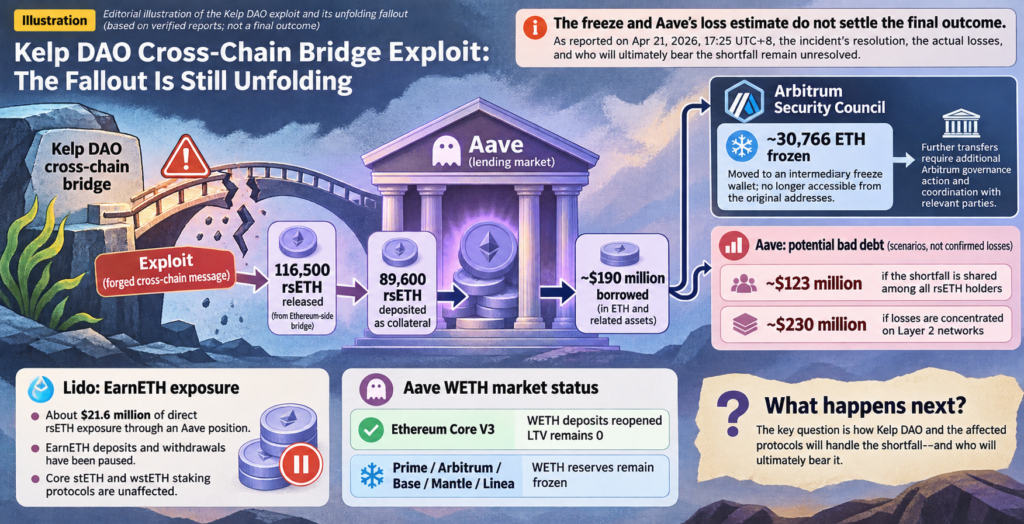
As reported on April 21, 2026, at 17:25 UTC+8, the fallout from the Kelp DAO cross-chain bridge exploit was still unfolding. Arbitrum’s Security Council had frozen about 30,766 ETH linked to the attacker, while Aave was assessing potential bad debt. Neither the freeze nor Aave’s loss estimate settles the final outcome.
What was frozen?
Arbitrum’s Security Council took emergency action to move the ETH into an intermediary freeze wallet. The funds could no longer be accessed from the addresses that previously held them; moving them again would require further Arbitrum governance action and coordination with relevant parties.
Why is Aave exposed?
According to Aave’s incident report, the attacker used a forged cross-chain message to release 116,500 rsETH from the Ethereum-side bridge, deposited 89,600 rsETH into Aave as collateral, and borrowed about $190 million in ETH and related assets. Aave estimated potential bad debt of roughly $123 million if the shortfall is shared among all rsETH holders, or about $230 million if losses are concentrated on Layer 2 networks. Those are scenarios, not confirmed losses.
Aave said WETH deposits had reopened on its Ethereum Core V3 market, although WETH’s loan-to-value ratio remained zero. WETH reserves on its Prime, Arbitrum, Base, Mantle and Linea markets remained frozen.
The effects extend beyond Aave. Lido said its EarnETH vault had about $21.6 million of direct rsETH exposure through an Aave position and had paused deposits and withdrawals. Lido said its core stETH and wstETH staking protocols were unaffected. The unresolved question is how Kelp DAO and the affected protocols will handle the shortfall—and who will ultimately bear it.