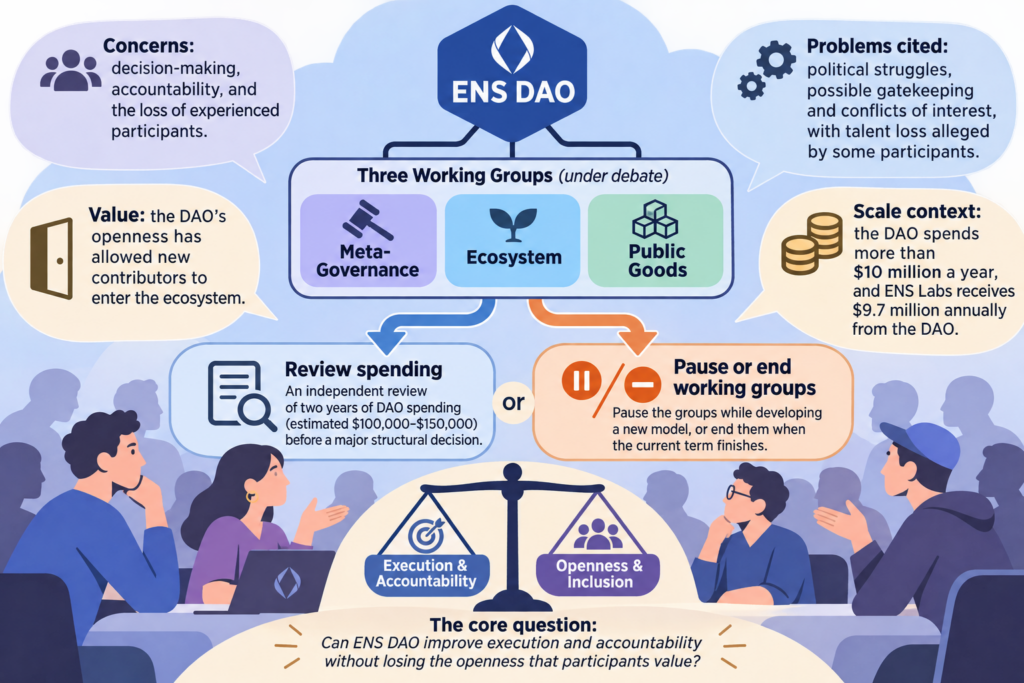
As reported on December 16, 2025, ENS DAO was debating whether to end its three working groups after contributors raised concerns about decision-making, accountability and the loss of experienced participants. The dispute was about how the organization should operate—not a change to ENS protocol rules.
The proposal and the objections
On November 14, ENS DAO secretary Limes proposed a temperature check to end the Meta-Governance, Ecosystem and Public Goods working groups when their sixth term finished on December 31, 2025. Limes, who said he had spent four years as a steward and two as secretary, argued that dependence on future funding discouraged frank criticism. He also argued that the open working-group structure made it difficult to select contributors by ability or remove poor performers. Those were his assessments, not established findings about every group or contributor.
ENS founder Nick Johnson wrote on November 18 that political struggles in the working groups had driven away committed contributors and could cause more to leave. He favored pausing, rather than abolishing, the groups while developing a sustainable alternative. He suggested that a management company could handle day-to-day operations and raised concerns about the DAO’s ability to meet legal obligations without professional contributors.
Other participants described the trade-off differently. Contributor jkm.eth credited ENS DAO’s openness with allowing him to enter the ecosystem, while acknowledging that other DAOs can shut capable newcomers out. Contributor ENSPunks.eth alleged gatekeeping, conflicts of interest and talent loss, and disputed how charter drafting and a conflict-of-interest policy had been handled. Those specific allegations were not independently resolved in the account.
Review first, or restructure now?
James proposed an independent review of two years of DAO spending—including grants, service providers and working groups—before a major structural decision. He invited Metagov to conduct it at an estimated cost of $100,000–$150,000. Johnson questioned spending more than $100,000 to identify inefficiency; James countered that the DAO spent more than $10 million a year and that $100,000 would be about 1% of that figure. Others, including Limes, argued that the problems were already clear enough to act without a review.
Contributor clowes.eth offered a further diagnosis: after attending all three groups’ weekly calls for much of 2025, he saw useful public-goods funding and administrative work, but few new participants in discussions. He said those participation measures had not been tracked, so his observation should not be read as a quantified trend. He also questioned how much oversight the DAO had of ENS Labs, which he described as receiving $9.7 million annually from the DAO to build ENSv2–Namechain. His suggested alternative was an operating company with accountable leadership. These were proposals and critiques, not adopted governance changes.
At the time of the December 16 report, the original proposal had been rejected by the community, the review and dissolution ideas were still under discussion, and elections had been delayed. The outcome of the governance debate remained uncertain. The underlying question was whether ENS DAO could improve execution and accountability without losing the openness that participants valued.