A report published on November 12, 2026, and attributed to Blockhead examines a shift among listed Bitcoin miners: some are converting power and facilities for AI customers, while others are selling Bitcoin to help fund that transition. Of the nine companies it reviewed, three already received more than half their revenue from activities outside mining.
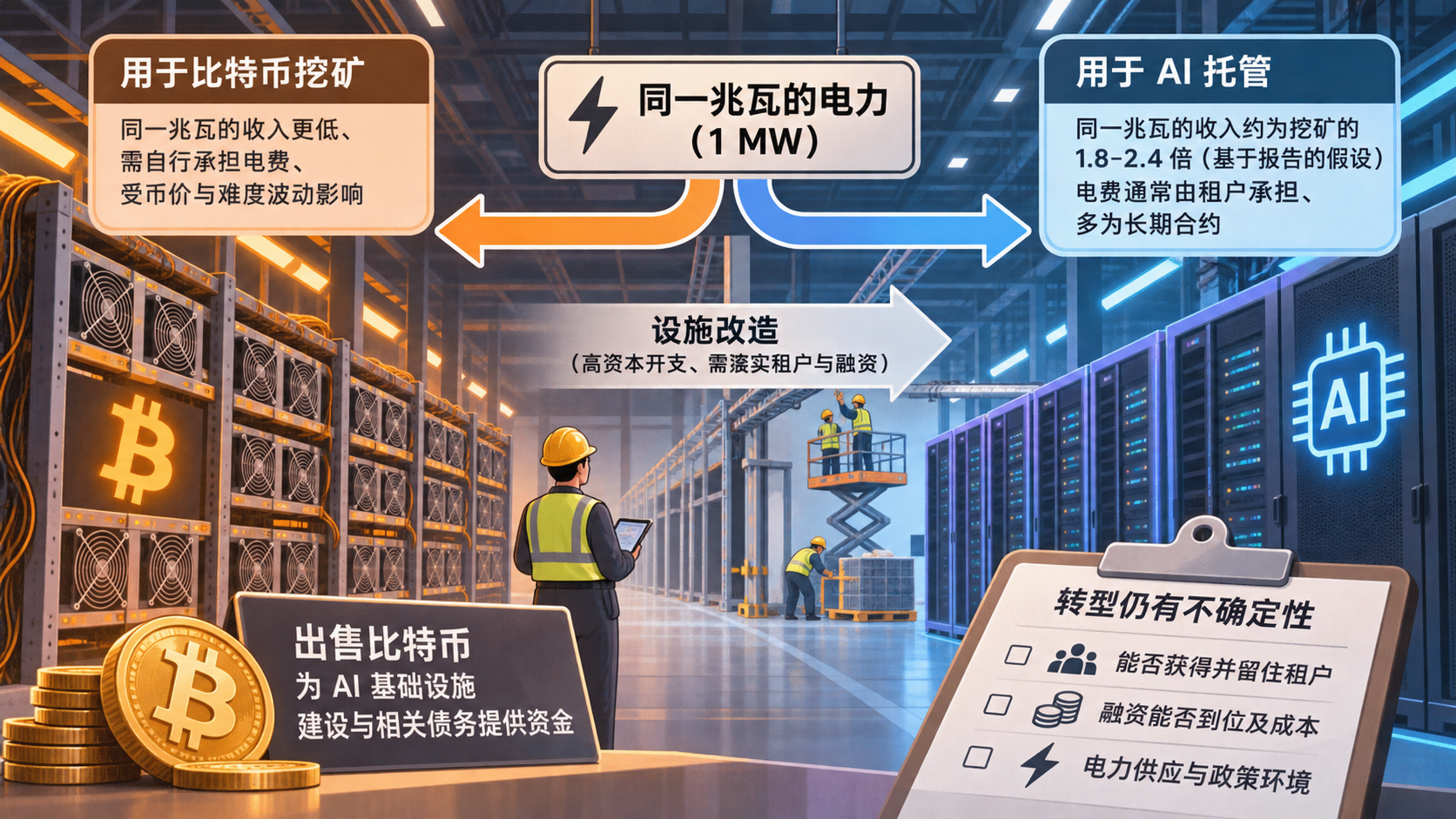
The appeal is not simply that AI is attracting attention. On the report’s assumptions, the same megawatt of power could bring in substantially more revenue through an AI hosting contract than through Bitcoin mining. Whether a miner can actually capture that difference depends on the cost of conversion, securing a tenant and financing the buildout.
What the megawatt comparison shows
According to MillionMiner data cited in the report, Bitcoin hashprice—the daily revenue earned per PH/s of computing power—fell from $40.24 on October 1 to $33.18 at the end of October, a 17.5% decline. MARA reported a cost of $30.80 per PH/s per day, leaving a margin of roughly 7% at the end-of-month hashprice on its own cost measure.
Core Scientific, by contrast, disclosed more than $700 million in annualized hosting revenue associated with 485 megawatts of billable power capacity. That works out to about $1.44 million per megawatt per year. Using the report’s stated mining-efficiency and hashprice assumptions, a megawatt devoted to mining would generate roughly $600,000–$800,000 in annual revenue before an estimated $350,000 electricity bill. On that basis, AI hosting revenue is about 1.8–2.4 times mining revenue per megawatt. These are comparisons based on disclosed figures and assumptions, not guaranteed returns from converting a site.
The businesses also carry different costs. The report says standard AI data-center contracts generally pass electricity costs to the tenant, whereas miners pay for power out of their variable Bitcoin revenue. Conversion requires substantial capital spending: Core Scientific reported $954.2 million in capital expenditure in the first half of the year.
Selling Bitcoin to finance the switch
The transition may affect Bitcoin selling even though it does not change the protocol’s issuance, which the report puts at roughly 450 BTC per day. Citing shareholder communications, it says MARA sold 17,488 BTC during the quarter—about 7.8 times the 2,247 BTC it mined—and planned further sales to fund AI infrastructure and meet note obligations. Riot sold 10,599 BTC in the third quarter; Hut 8 sold about 3,100 BTC across the quarter and October.
Together, those sales total roughly 31,000 BTC, or about 69 days of issuance at the report’s stated rate. That is a scale comparison, not a measure of newly mined coins sold: the reporting windows differ, and the sales include Bitcoin already held in company treasuries.
What remains uncertain
Moving toward AI does not remove risk; it changes its form. The report points to long-term hosting contracts, but their value depends on tenants, financing and power availability. It says Core Scientific expected to finish exiting Bitcoin mining in the fourth quarter and become a hosting-only provider in 2027, while IREN expected to be substantially through its mining transition by the end of 2026. Those were company expectations, not completed changes at the time of reporting.
The evidence supports a narrowing margin for some miners and a strong incentive to pursue AI hosting where conversion is feasible. It does not establish that every mining site can secure an AI tenant—or that contracted revenue will translate into profit after construction and financing costs.