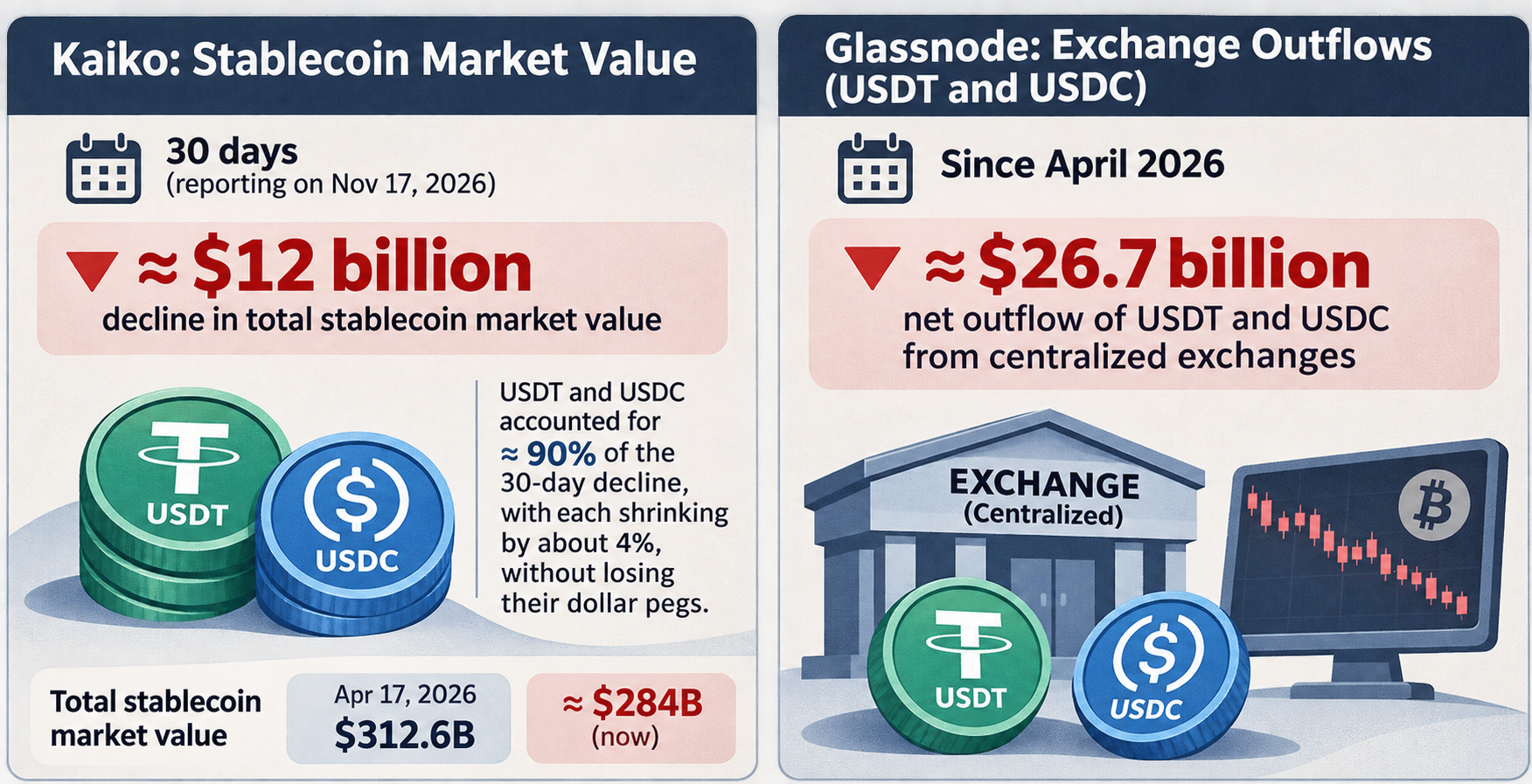
In reporting published on November 17, 2026, Kaiko said the stablecoin market had lost about $12 billion in value over the preceding 30 days—its fastest contraction since the 2022 Terra-Luna collapse. The decline came as Bitcoin fell to a nearly four-month low.
Where did the stablecoins go?
USDT and USDC accounted for roughly 90% of the 30-day decline, according to Kaiko. Its research head, Anastasia Melachrinos, said both shrank by about 4% without losing their dollar pegs. She interpreted the parallel declines as a sign that holders were cashing out into dollars rather than switching from one issuer to the other. That is an interpretation of the data, not a transaction-by-transaction account of where all the money went.
Glassnode researcher Sean Rose put net outflows of USDT and USDC from centralized exchanges at about $26.7 billion since April 2026. That is a different measure and time period from the $12 billion market-wide, 30-day decline. Glassnode also put total stablecoin market value at approximately $284 billion, down from a reported peak of $312.6 billion on April 17, 2026. Rose noted that, unlike the 2022–23 contraction—when USDT expanded as other stablecoins shrank—both USDT and USDC were declining this time.
What remains uncertain
The report linked thinner trading liquidity to a sharp Bitcoin sell-off during the preceding weekend, when it said the price fell as much as 8% within hours. It also described a decline of more than 20% over the preceding month. Those moves do not, by themselves, establish why stablecoin balances fell.
One proposed explanation was that investors were raising cash for an anticipated Anthropic IPO. Crypto hedge fund Tagus Capital compared Bitcoin ETF outflows with an earlier fundraising pattern it associated with SpaceX and cited a third consecutive week of ETF net outflows. It also pointed to a Hyperliquid perpetual-contract valuation near $1.8 trillion—more than 25% above a purported $1.4 trillion upper filing valuation—and suggested fundraising could reach $100 billion. Those were Tagus Capital’s claims and speculation; the supplied report did not establish that an Anthropic listing was scheduled or that crypto sales were funding it.
The report also cited a purported Binance hack, US policy uncertainty after the midterm elections, rising Treasury yields and a stronger dollar as possible pressures. It did not demonstrate how much, if any, each contributed to the stablecoin decline. The clearest supported takeaway is narrower: two leading stablecoins contracted together while exchange-held balances fell, leaving less stablecoin capital on trading venues.