This report is from November 24, 2026. On November 23, Litecoin’s official X account said Mimblewimble Extension Block (MWEB) transactions had run at four times their previous daily average across a 10-day stretch. The same day, Canton Network restated that Greywick Digital is developing cLTC, a reserve-backed Litecoin token with a late-2026 mainnet target. That token was still a plan, not a live asset.
What the activity post actually showed
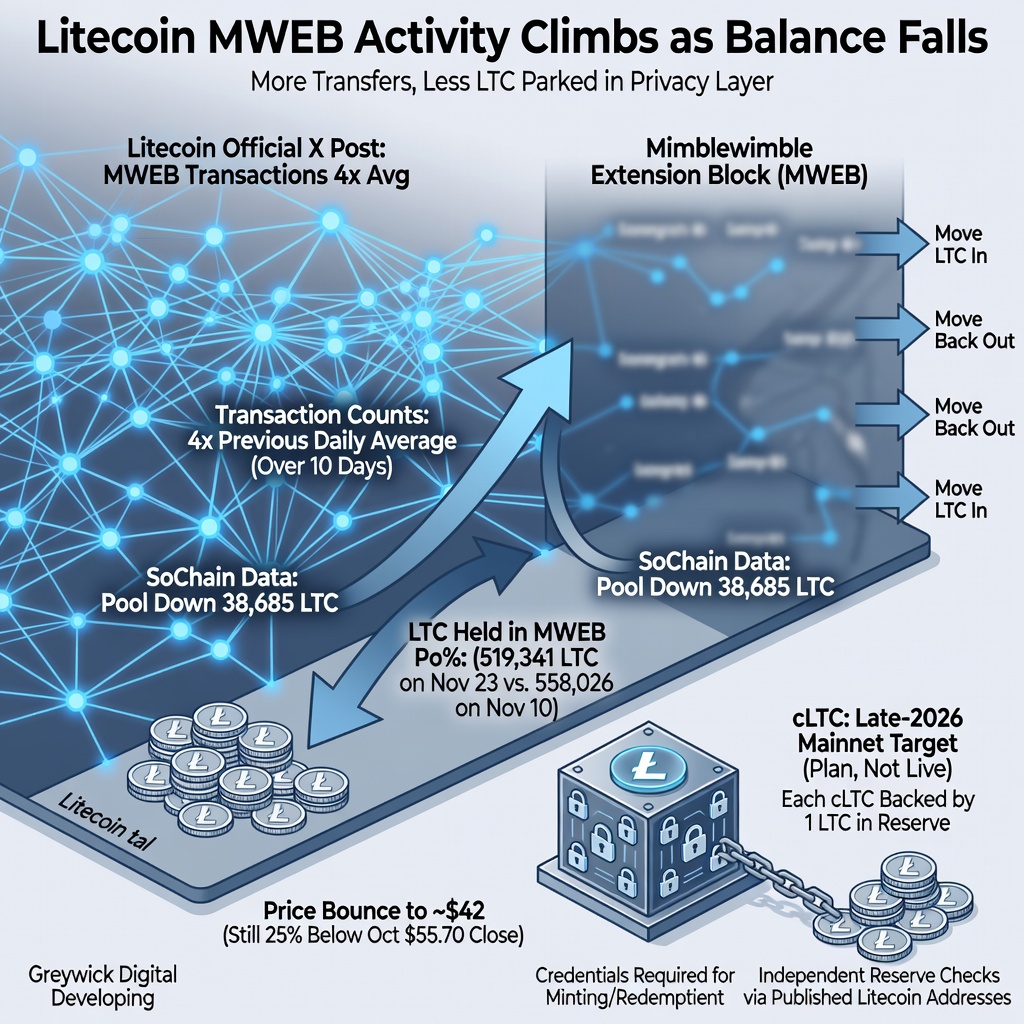
Litecoin attached an MWEB chart to the November 23 post. Counts that sat at a few hundred on many earlier days climbed above 2,000 on several days in November. The account described the stretch as a consistent 4x versus the prior daily average, and it urged people to set up optionally private Litecoin, tagging Nexus Wallet, @vikrantnyc, Stack Wallet, and Litecoin Core.
MWEB went live in May 2022. Users can move LTC from the main chain into the extension blocks, where transfer amounts are hidden from public view, and move coins back later. A payment made through MWEB uses the same LTC that circulates on the main chain.
Transfers rose while the pool shrank
Transaction counts and the amount of LTC held in MWEB moved in opposite directions. SoChain put the pool at 519,341 LTC on November 23, compared with 558,026 LTC on November 10. The difference was 38,685 LTC, roughly 7% lower. Coins can move between users inside MWEB without changing that total. The pool rises or falls only as coins enter or leave.
That split limits what the spike shows. The explorer counts activity on the extension blocks. A single wallet or service can generate repeated transactions, and the chart gives each of those transfers the same weight as one from a new user. The figures describe how often the feature was used over those 10 days. They do not show a matching increase in LTC parked in the privacy layer.
The price bounce stayed well under the October close
CoinGlass data showed LTC trading near $42 on November 23, up from a low of $37.73 on November 21. It had ended October 2026 at $55.70, so the November 23 level was still about 25% below that close. The report places the bounce next to the MWEB counts. It does not establish that the privacy-layer activity caused the move.
cLTC remained a late-2026 target
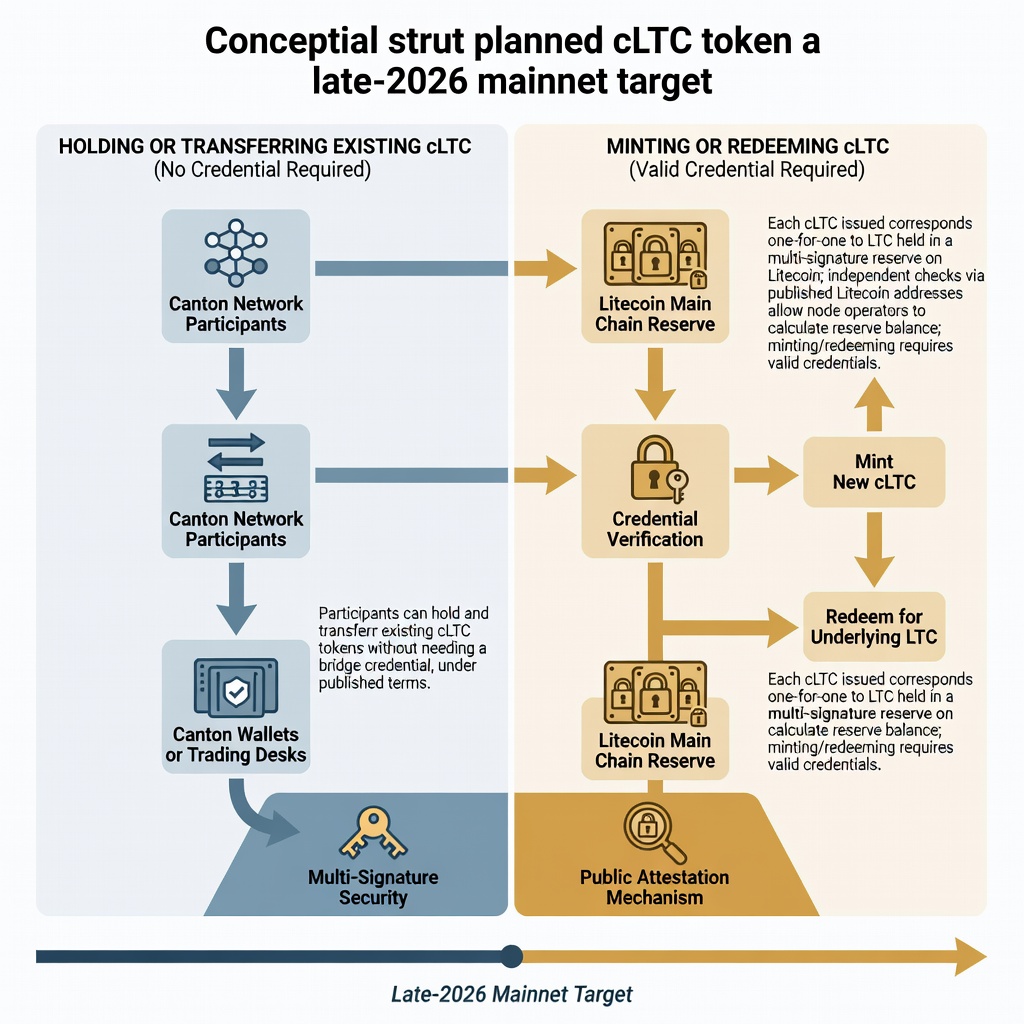
Canton Network said on November 23 that Greywick Digital was developing cLTC with a late-2026 mainnet target. The Litecoin Foundation has endorsed the project. Under Greywick’s terms, each cLTC issued on Canton would correspond to one LTC held in reserve on Litecoin.
Greywick says the reserve would require multiple signatures to move funds, and that independent checks would use published Litecoin addresses. The company also says it will publish how those addresses are derived, so someone running a Litecoin node can calculate the reserve balance independently. Transaction details on Canton would be visible to the parties involved, while anyone could check the Litecoin backing.
The published terms separate using a token that already exists from creating or cashing one out. Canton participants could hold and transfer cLTC without a bridge credential. Minting new tokens, or redeeming them for the underlying LTC, would require a valid credential.
David Schwartz, the Litecoin Foundation’s director of strategic partnerships, said in a statement published by Greywick, “Litecoin is for everyone.” He said the Canton project could put Litecoin in front of institutions that might otherwise have no reason to use existing routes to access it. That is his view of a possible audience, not evidence that those institutions have signed on.
Greywick says it plans to start with a cap on the reserve and raise it after periods of smooth operation. Its terms also say the amount of cLTC in circulation would be limited by the independently attested reserve. The company is pitching cLTC to trading desks, funds, and treasury companies that want to use LTC as collateral without selling it. The report does not show that those firms have taken it up.
Canton has also drawn other traditional-market proposals. In April, S&P Dow Jones Indices and Kaiko unveiled plans to bring the iBoxx Treasury index to the network, with licensing terms and access controls built into a smart contract. The report describes those as plans, not as an activated index product.
Exchanges have long set their own MWEB rules
Making privacy optional still left venues free to decide which transfers they accept. Several South Korean exchanges moved to delist LTC in June 2022 after the upgrade. Upbit cited South Korean rules on anonymous transactions in its decision to end support for the asset.
The feature has also faced technical setbacks. In April 2026, Litecoin reversed 13 blocks after an incident involving MWEB. The Litecoin Foundation said it patched the bug.
Other exchanges drew the line at the transfer method. In its June 2022 support notice, Binance said it would reject MWEB deposits and withdrawals and could neither credit nor return deposits sent through the feature, because it could not verify the sender’s address. Thailand’s Bitkub, in a February notice, cited securities-regulator rules and excluded MWEB deposits and withdrawals.
The November 2026 attention pairs a short run of heavier MWEB use with a restated institutional-token timeline. The usage increase is what Litecoin reported, and the coins held in that layer were lower, not higher. cLTC was still aimed at a late-2026 mainnet, tied to Greywick’s reserve design and to credentials for minting and redemption.