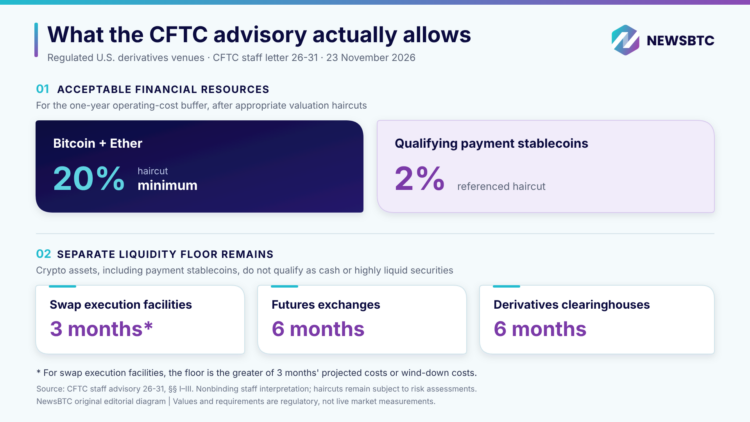
Reporting on November 24, 2026 focused on a Commodity Futures Trading Commission staff advisory issued the day before, on November 23. The advisory says swap execution facilities, designated contract markets, and derivatives clearing organizations may count Bitcoin, Ether, and qualifying payment stablecoins toward certain financial-resource requirements. It is staff guidance, not a binding rule adopted by the full Commission, and nothing in it requires institutions to buy Bitcoin.
What the advisory allows
Those venues must maintain financial resources sufficient to cover at least one year of operating costs. Under the November 23 staff guidance, Bitcoin, Ether, and qualifying payment stablecoins may contribute to that calculation, subject to valuation discounts.
The advisory references a minimum 20% haircut for Bitcoin and Ethereum, consistent with earlier staff treatment of proprietary cryptocurrency positions held by futures commission merchants. Qualifying payment stablecoins are referenced with a 2% haircut. Crypto that is neither readily marketable nor a qualifying payment stablecoin would generally face a 100% haircut, which would leave it out of the calculation.
The reporting uses a simple example: an exchange holding $10 million in Bitcoin could count $8 million toward the relevant requirement if it applied a 20% haircut and no further deductions were necessary. The remaining $2 million is described as a regulatory adjustment for the risk of a volatile asset, not a realized loss.
The same reporting places the advisory after broader efforts to fit digital assets into regulated market infrastructure, including earlier coverage of CFTC guidance on tokenized collateral at clearinghouses. This document is about assets the institutions running the markets can rely on for operating resources, not what traders post as collateral.
Cash is still a separate line
Bitcoin, Ethereum, and even qualifying payment stablecoins cannot be used to meet the separate requirement for cash and highly liquid securities.
Swap execution facilities must hold qualifying liquid resources sufficient to cover at least three months of projected operating expenses, or the cost of winding down, whichever is greater. For designated contract markets and derivatives clearing organizations, the operating-cost liquidity requirement generally covers at least six months.
The guidance also does not address whether cryptocurrencies can satisfy the separate financial resources that clearinghouses must maintain to cover clearing-member defaults.
The wrong-way risk warning
CFTC staff specifically state that a designated contract market should consider potential wrong-way risk. For a cryptocurrency-focused exchange, a prolonged Bitcoin sell-off could pressure trading revenue while also reducing the value of the assets the business relies on to support operations. A 20% valuation discount is a buffer against that overlap, not a guarantee.
Why the attention outruns the evidence
The attention comes from a simple reading: if regulated venues can get more use from holding Bitcoin, more of them might eventually allocate to it. The reporting notes some basis for that view, including earlier coverage of Coinbase’s CFTC registration for a USDC-focused derivatives clearinghouse, as one sign that crypto businesses are operating inside established frameworks. The November 23 advisory gives relevant institutions another reason to look at how digital assets sit on the balance sheet.
That is not the same as an incentive to buy more. A venue that already holds Bitcoin could benefit without purchasing another coin. Another could still find conventional securities more efficient because of the haircuts and the separate liquidity rule. No purchase commitments were disclosed with the announcement.
The document remains a staff advisory. It does not amend existing regulations or create enforceable rights. Whether regulated institutions actually change reserve allocations is still unshown. Until there is evidence of that, the development is another form of regulatory recognition, not demonstrated buying pressure.