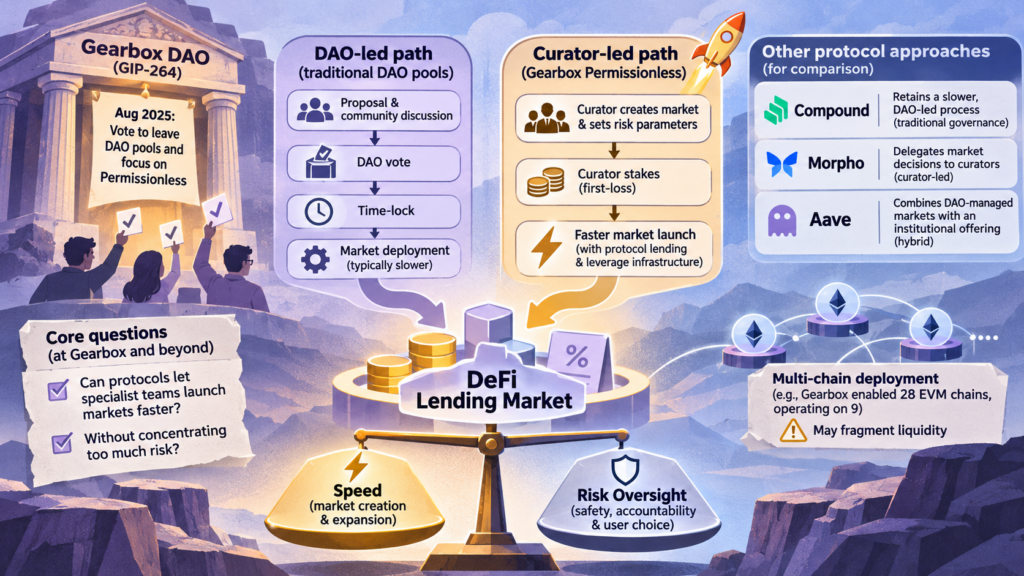
In a November 24, 2025 analysis, 0xResearcher examined a question facing DeFi lending: can protocols let specialist teams launch markets faster without concentrating too much risk? The central example was Gearbox, whose DAO voted in August 2025 to move away from traditional DAO-governed pools and focus on its Permissionless model.
What changed at Gearbox
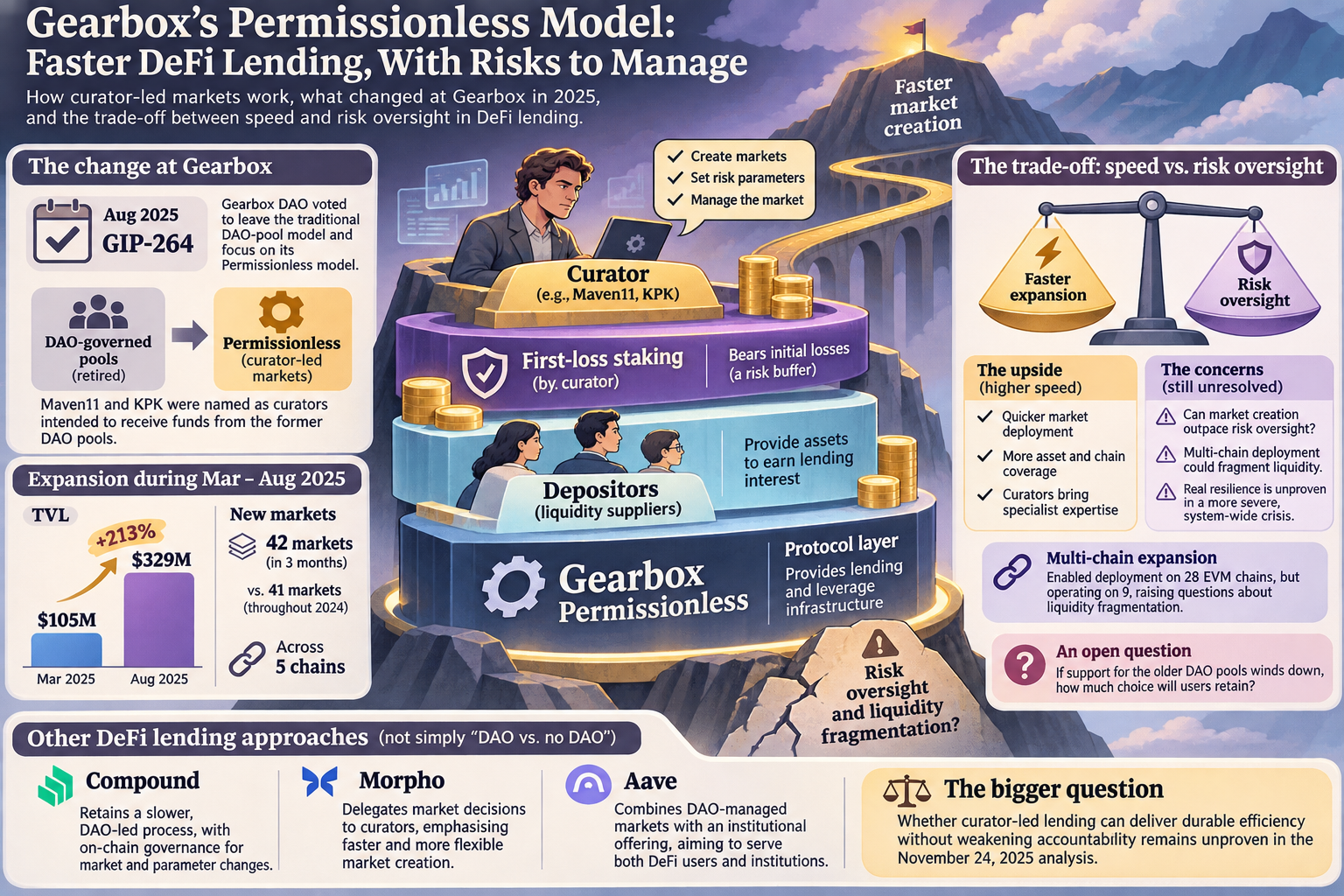
Gearbox introduced Permissionless in March 2025. Under the model described in the analysis, curators create markets and manage their risk settings, while the protocol supplies lending and leverage infrastructure. Curators are also meant to bear first losses through staking.
The analysis reports that Gearbox’s total value locked (TVL) rose from $105 million in March to $329 million in August 2025, a 213% increase. It also says Gearbox deployed 42 new markets across five chains in three months, compared with 41 markets throughout 2024. Those figures show expansion during the period; they do not establish that the governance change caused it or that the resulting markets are safer.
In August, the Gearbox DAO approved proposal GIP-264 to leave the traditional DAO-pool model behind. According to the analysis, Permissionless pools then represented more than 70% of Gearbox’s TVL. Maven11 and KPK were named as curators intended to receive funds from the former DAO pools. The analysis raises an unresolved question: how much choice users would retain if support for the older pools wound down.
Speed has a trade-off
The comparison is not simply “DAO versus no DAO.” The analysis describes Compound as retaining a slower, DAO-led process; Morpho as delegating market decisions to curators; and Aave as combining DAO-managed markets with an institutional offering. Each approach places operational decisions—and responsibility for them—in different hands.
For Gearbox, the clearest concern is whether faster market creation outpaces risk oversight. The analysis says the protocol had enabled deployment on 28 EVM chains but was operating on nine. It argues that spreading markets across chains could fragment liquidity. It also notes that Gearbox cited zero bad debt during an October 10, 2024 market swing, while cautioning that this was not a test of a more severe, system-wide crisis.
The August vote is a concrete governance decision. Whether curator-led lending delivers durable efficiency without weakening accountability remained unproven in the November 2025 analysis.