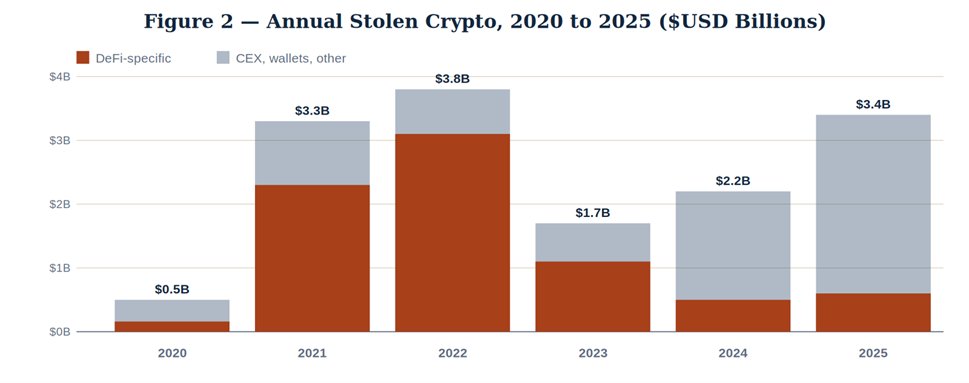
As reported on April 27, 2026, an analysis of two recent attacks argued that DeFi stablecoin deposit rates may not adequately compensate lenders for the risks they take. Its central question is not whether a 5% yield is attractive in isolation, but what losses that yield is expected to cover.
On April 1, Drift Protocol lost a reported $285 million after an administrator’s private key was targeted through social engineering. On April 18, an attack on KelpDAO caused a reported $292 million loss. The analysis says stolen rsETH was subsequently deposited as collateral on Aave V3, leaving Aave with about $196 million in bad debt. Together, the two attacks account for the cited $577 million in losses; the Aave bad-debt figure describes a downstream consequence and should not be added to that total.
The analysis also reports that Aave’s total value locked fell from $26.4 billion to $17.9 billion over three days. That change in TVL measures assets held in the protocol, not an equivalent amount stolen. It says utilization in Aave’s USDC lending market reached 99.87% for four consecutive days and the deposit rate rose to 12.4%. Circle chief economist Gordon Liao proposed quadrupling a borrowing cap to ease withdrawal demand; the proposal was not described as an enacted change.
What a deposit rate has to cover
The author borrows a bond-pricing framework: a baseline interest rate, expected losses, compensation for uncertain outcomes and a liquidity premium. Applied to DeFi, the analysis highlights risks that a borrower’s credit rating alone would miss: smart-contract exploits, oracle or governance attacks, and losses spreading between interconnected protocols. The KelpDAO–Aave episode is presented as an example of that last risk—not as evidence that Aave itself was hacked.
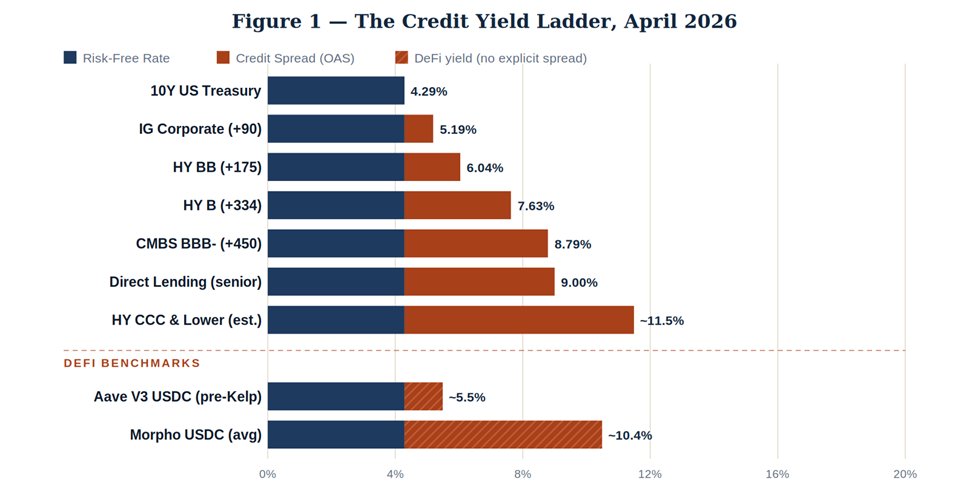
Before the KelpDAO attack, the analysis puts Aave USDC deposit yields at roughly 5.5%, compared with about 10.4% for selected, actively managed Morpho vaults. Those rates are observations, not proof that the products have identical risks or that the higher-yielding option is safer.
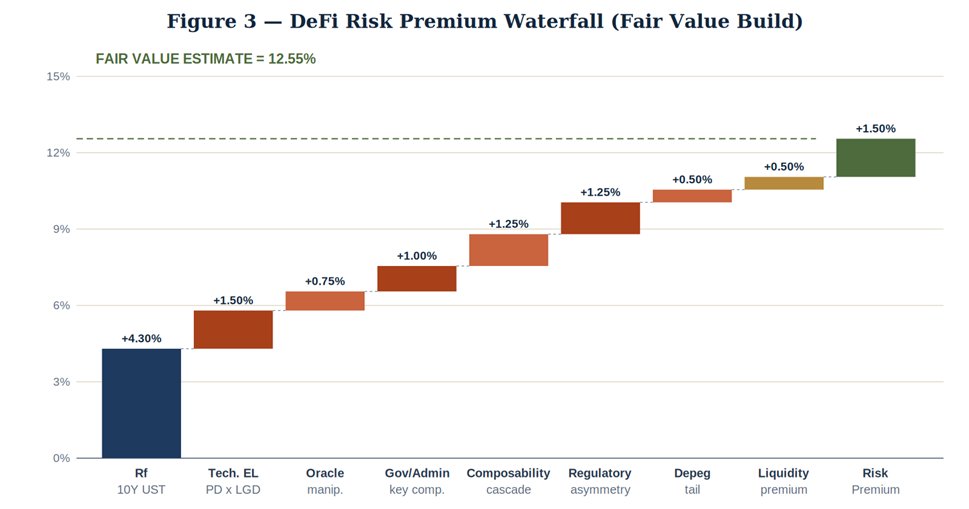
Using a 4.30% ten-year US Treasury benchmark and its own estimates for expected losses and several risk premiums, the author calculates a 12.55% illustrative annual yield for a major-protocol USDC deposit. The inputs—including a 1.5% expected-loss allowance—are judgments in a pricing model, not a measured market-wide fair rate or a guaranteed return. The analysis concludes that insurance, reserves, collateral quality and cross-chain exposure could materially change the rate a particular deposit warrants.
The takeaway is a question for evaluating any quoted yield: which risks sit behind it, and who bears the loss if an upstream protocol fails? The reported attacks show why deposit rates can move sharply under stress. They do not, by themselves, establish one correct yield for every DeFi lender.