Four years after FTX filed for bankruptcy on November 11, 2022, attention has turned to a different question: how much has it cost to recover and distribute the failed exchange’s assets? In an article originally published on November 12, 2026, at 11:00:42 UTC+8, David of TechFlow examined the professional fees—and the debate over what creditors received in return.
The cost of sorting out FTX
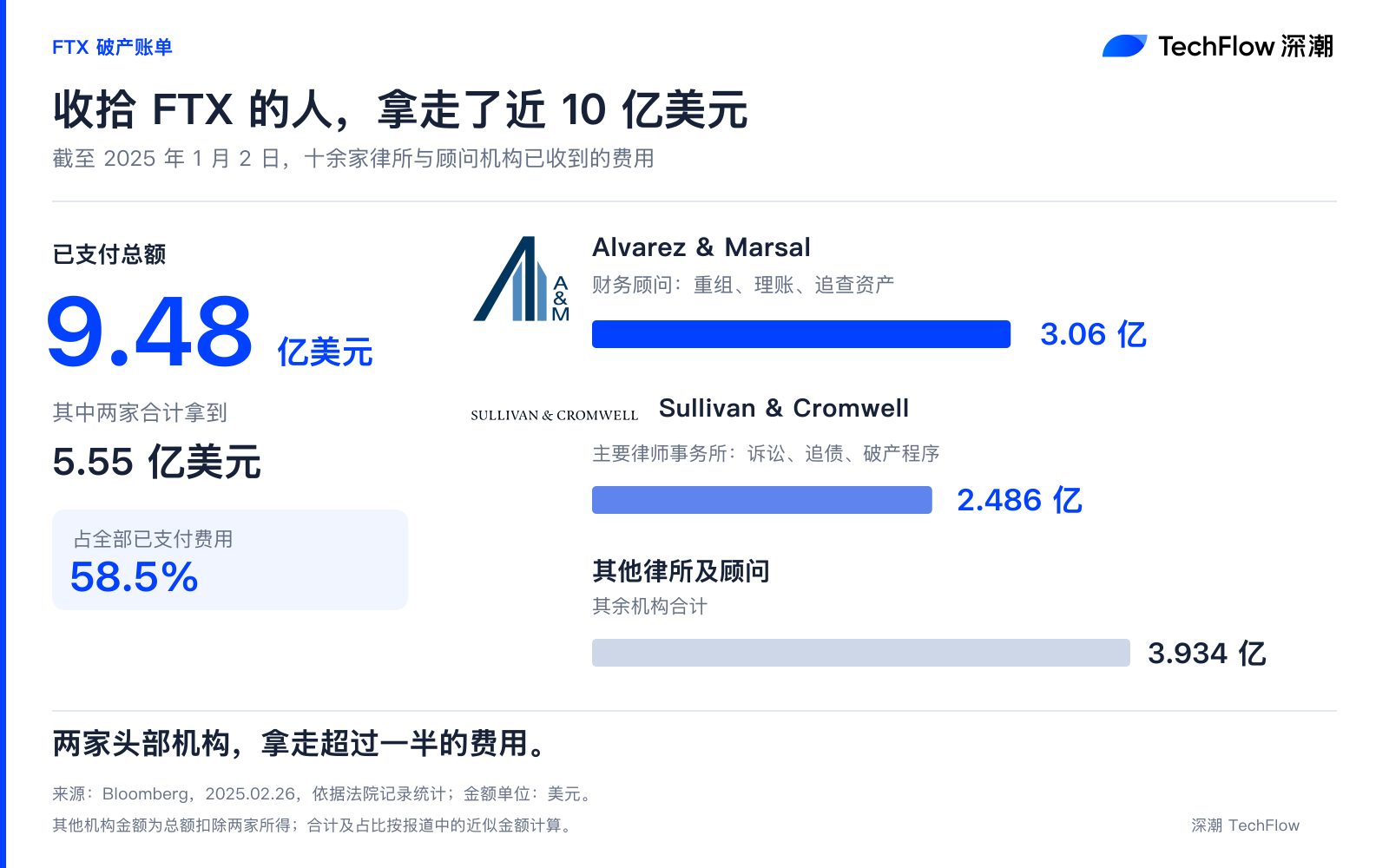
Citing Bloomberg’s review of court records, TechFlow reported that FTX had paid approximately $948 million to more than a dozen firms by January 2, 2025. That included about $306 million to restructuring adviser Alvarez & Marsal, $249 million to law firm Sullivan & Cromwell (S&C), and $110 million to lawyers and advisers hired by the creditors’ committee.
The work was extensive: FTX’s assets and records were spread across more than 130 affiliated companies. Court-appointed fee examiner Katherine Stadler reviewed $88.8 million in bills from the first three months and recommended approval of $85.1 million. In a June 2023 report, she described the fees as striking while also praising the professionals’ work, according to TechFlow.
There is a concrete counterpoint to the cost criticism. TechFlow, citing experts quoted by Bloomberg, reported that creditors could recover 118% and attributed that outcome in part to advisers tracking down assets. That reported recovery figure should not be read as proof that every creditor had already received 118%.
The contested trade-offs
TechFlow also questioned whether the estate gave up potential gains when it sold its stake in Anthropic. FTX had invested $500 million for roughly 8% of the company in 2021; the bankruptcy team sold the stake in two batches in the first half of 2024 for about $1.3 billion in total. The article argues that holding it longer might have produced a higher return as Anthropic’s valuation rose. That is a hypothetical opportunity cost, not a realized loss or proof that retaining the stake would have been the better decision at the time.
Another dispute concerns S&C’s role. TechFlow reported that a group of creditors sued the firm in early 2024, alleging it had been deeply involved with FTX before the collapse, including work on as many as 20 legal matters in the preceding 16 months. Those are the creditors’ allegations, not established findings. S&C sought dismissal, citing the bankruptcy court’s determination that it was a disinterested party.
The fee totals show the scale of the cleanup; the reported recovery figure shows why judging it by cost alone is incomplete. Whether particular expenses or asset sales best served creditors remains a separate, contested question.
Source: techflowpost.com (originally published 2026-11-12 11:00 UTC+8)