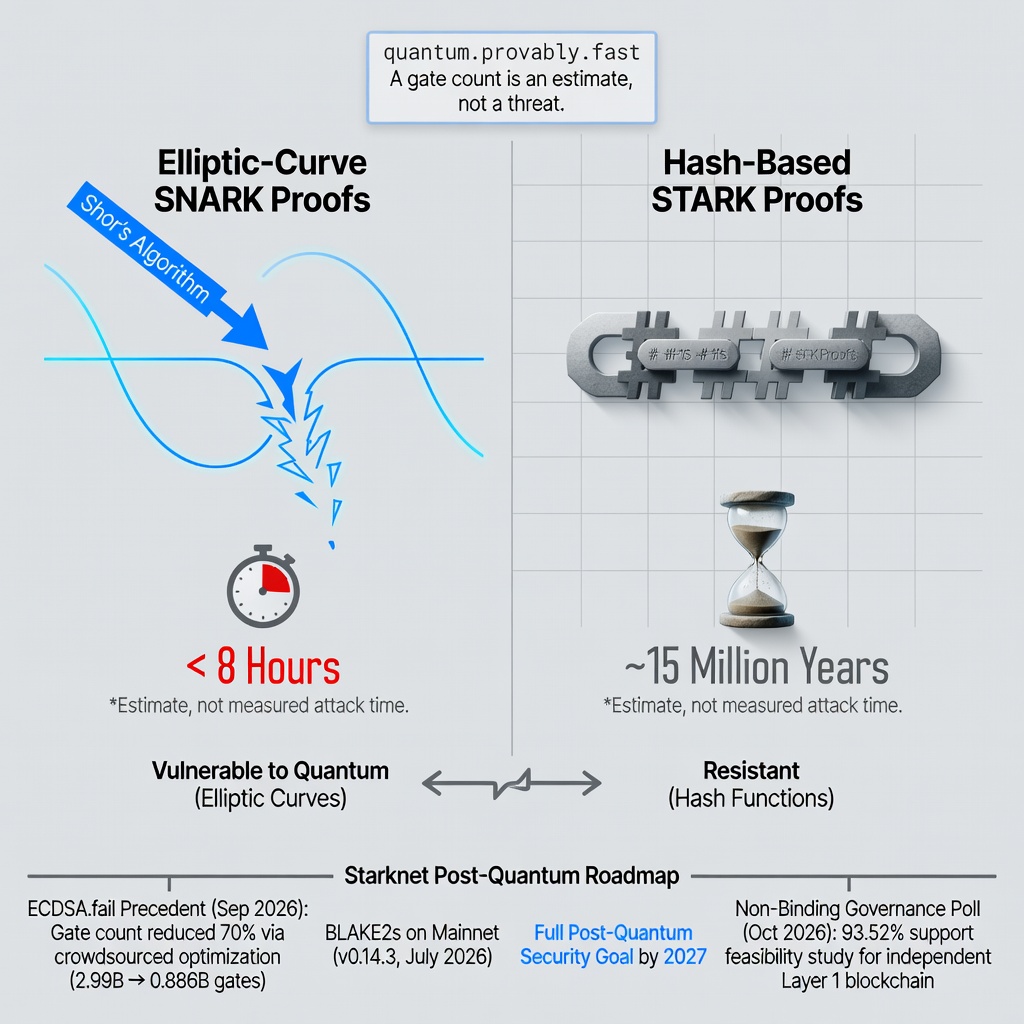
As reported on November 26, 2026, at 10:37 EST, Starknet was pointing readers to a public benchmark with a striking estimate: a future quantum computer could forge an elliptic-curve SNARK proof in under eight hours, while an attack on a hash-based STARK could take about 15 million years. Neither figure is a measured attack time. Both depend on assumptions about future hardware, error correction and circuit design.
What the benchmark measures
SNARKs and STARKs let someone verify a computation without repeating the work. The pairing-based SNARKs assessed by the benchmark rely on elliptic curves, whose underlying math is vulnerable to Shor’s algorithm on a sufficiently capable quantum computer. STARKs rely on hash functions, which do not share that particular weakness.
The public board at quantum.provably.fast lets researchers submit quantum circuit designs and compare the number of gates they require. Fewer gates mean a lower estimated cost, not that a machine capable of running the circuit exists. As the board puts it, “A gate count is an estimate, not a threat.”
Its model is ECDSA.fail, an Eigen Labs initiative focused on point addition on the secp256k1 curve. According to findings published on arXiv in September 2026, more than 100 participants, including StarkWare researchers, helped cut the resource estimate from Google Quantum AI’s benchmark of approximately 2.99 billion gates to around 0.886 billion. That roughly 70% reduction came from better circuit designs, not new hardware.
Where Starknet’s roadmap stands
Starknet uses STARK proofs, which explains its interest in the comparison. But the strength of its proof system does not settle whether the whole network is secure against quantum attacks. StarkWare’s June 2026 roadmap called for replacing remaining dependencies on Pedersen hashing with BLAKE2s. BLAKE2s reached Starknet mainnet in July with version v0.14.3, and researchers also described work on post-quantum accounts and hashes on mainnet. Full post-quantum security by 2027 remained a goal, not a completed upgrade.
A separate October 2026 governance poll found that 93.52% of participants supported researching an independent Layer 1 blockchain so Starknet could run its upgrade cycles separately from Ethereum. The poll was non-binding: participants backed a feasibility study, not a decision to launch a chain.