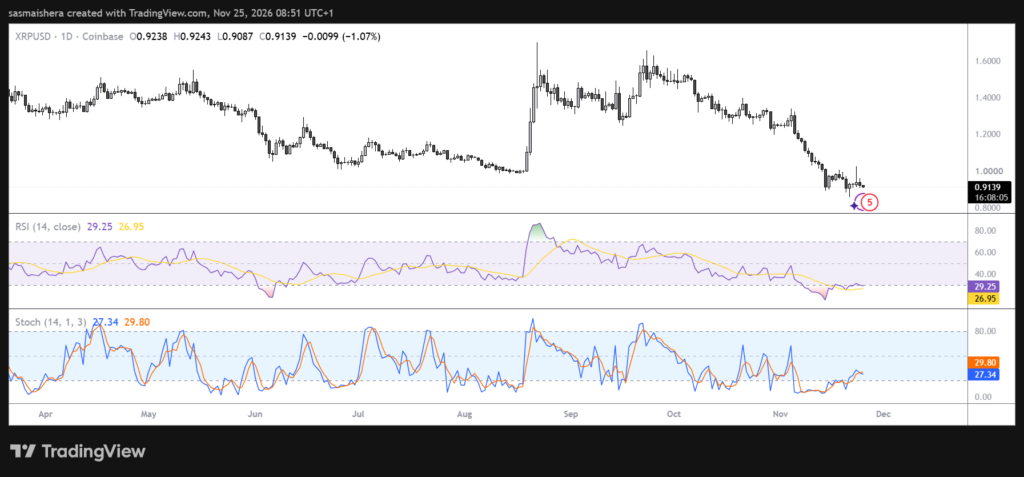
XRP fell nearly 3% on November 25, 2026, and found temporary support near $0.91. An earlier attempt that week to break above $0.96 met selling pressure, triggering liquidations of leveraged positions below $0.94.
Why $0.94 matters on a rebound
CoinGlass’s liquidation heatmap showed a concentration of leveraged short positions between $0.93 and $0.94. A rise into that range could force short sellers to buy XRP to close their positions. That buying could briefly lift the price without signaling a broader recovery in demand.
The one-hour chart also showed an area near $0.934 where sellers could reappear. XRP’s Relative Strength Index was approaching 26, and the price had fallen below its 200-period exponential moving average. Both indicators pointed to weak short-term momentum.
The downside scenario depended on what happened after a bounce: if XRP briefly cleared $0.94 and then reversed into a sustained decline below $0.90, further liquidations could push it toward $0.87. A decisive break below $0.87 could bring $0.80 into view. Neither $0.87 nor $0.80 was a reported price in the sell-off.
What the inflation forecast did—and didn’t—show
Economists expected a 0.3% monthly rise in the core Personal Consumption Expenditures Price Index, the Federal Reserve’s preferred inflation measure. That was a forecast, not a released figure. Investors were already pricing in rate increases in December and January. A higher-than-expected inflation reading could fuel speculation about a larger, 50-basis-point increase in December and make interest-bearing assets more attractive relative to crypto.
The Crypto Fear and Greed Index fell to 9, its lowest reading since February. That signaled extreme fear across the crypto market, not a prediction of how far XRP would fall. The Democrats’ US midterm election victory also left the pace of digital asset legislation uncertain. The concern was that XRP could give back some of its gains during the Trump administration if investors expected slower legislative progress—not that a change in crypto law had taken effect.