On November 8, 2026, Vitalik Buterin published a long post on X reopening a basic question about ETH: if fee burns are no longer a dependable support for price, what is?
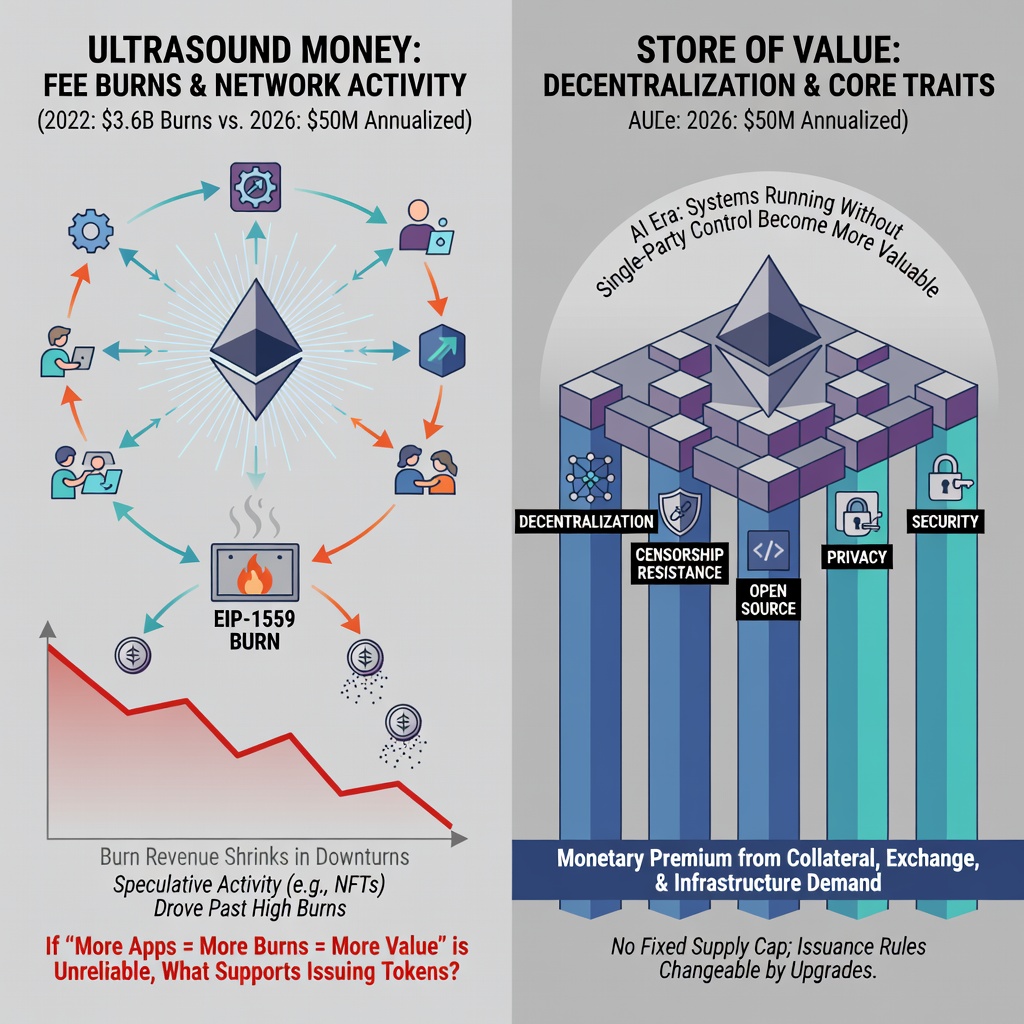
For years the leading story was “ultrasound money.” Busy applications raise gas use, EIP-1559 burns the base fee, and those burns can offset new issuance or even shrink supply. Buterin argued that fee destruction was never a reliable valuation floor. A large share of past fees came from speculative activity inside crypto markets, so burn revenue shrinks when markets turn down. He still supports keeping EIP-1559. Even if burns remain below 10% of new issuance for a long time, he said that is not a reason for regret. Pushing fees higher on purpose, just to keep burns large, could hurt decentralization and long-term development.
That raises a wider issue. If “more applications, more burns, a more valuable token” is unreliable, what is supposed to support public-chain tokens that keep issuing new supply?
Issuance versus burns, chain by chain
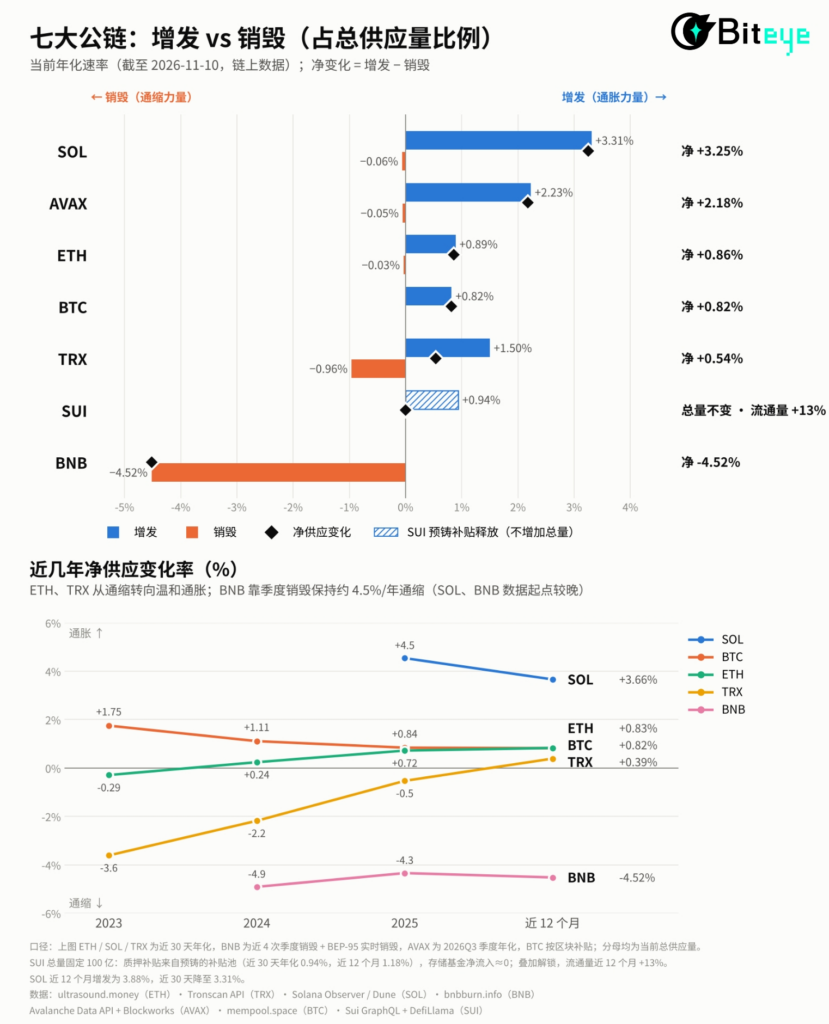
An Odaily report published on November 11, 2026 compared how several networks add and remove supply.
Bitcoin. The cap is about 21 million BTC. The current block reward is 3.125 BTC. At roughly one block every ten minutes, that is about 164,300 new BTC a year, or about 0.82% annual supply inflation. Halvings keep pushing that rate down.
Ethereum. Since the 2022 Merge, cumulative supply growth has been about 1.37%. EIP-1559 burns the entire base fee, but layer-2 adoption and lower gas costs have changed the math. Over the most recent 30 days, burns offset only about 3.2% of new issuance, putting the old deflation story under strain.
Solana. Initial inflation was 8%, falling 15% a year toward a 1.5% long-term target. During the 2024 meme surge, daily burns at times exceeded 10,000 SOL. In January 2025, burns offset about 23% of new issuance. After SIMD-0096, priority fees go entirely to validators and only 50% of the base fee is burned. Daily burns later dropped to around 700 SOL.
BNB. There is no ongoing issuance. Supply is reduced by quarterly Auto-Burn and real-time BEP-95 gas burns, with a target of 100 million BNB. The first four quarterly burns of 2026 removed about 6.2 million BNB. Auto-Burn depends on price and the number of blocks produced; BEP-95 burns part of network fees.
TRON. TRX is issued through block rewards, while fees users pay for Energy and Bandwidth are burned. Users can also get those resources by staking or renting, so more USDT transfers do not automatically mean more TRX is burned.
Avalanche. The cap is 720 million AVAX. New issuance rewards validators, while fees on the X, C, and P chains are fully burned. As of early November 2026, about 474 million AVAX had been minted, including about 114 million in staking rewards, while cumulative burns were about 5.18 million — not enough to offset new issuance.
Sui. Total supply is fixed at 10 billion. Circulating supply mainly rises through unlocks. A Storage Fund locks part of storage fees and compensates validators with staking yield. Deleting data returns most of the fee; the unreturned share stays in the fund and reduces freely circulating supply, but it is not a permanent burn.
A burn-based price model that does not hold
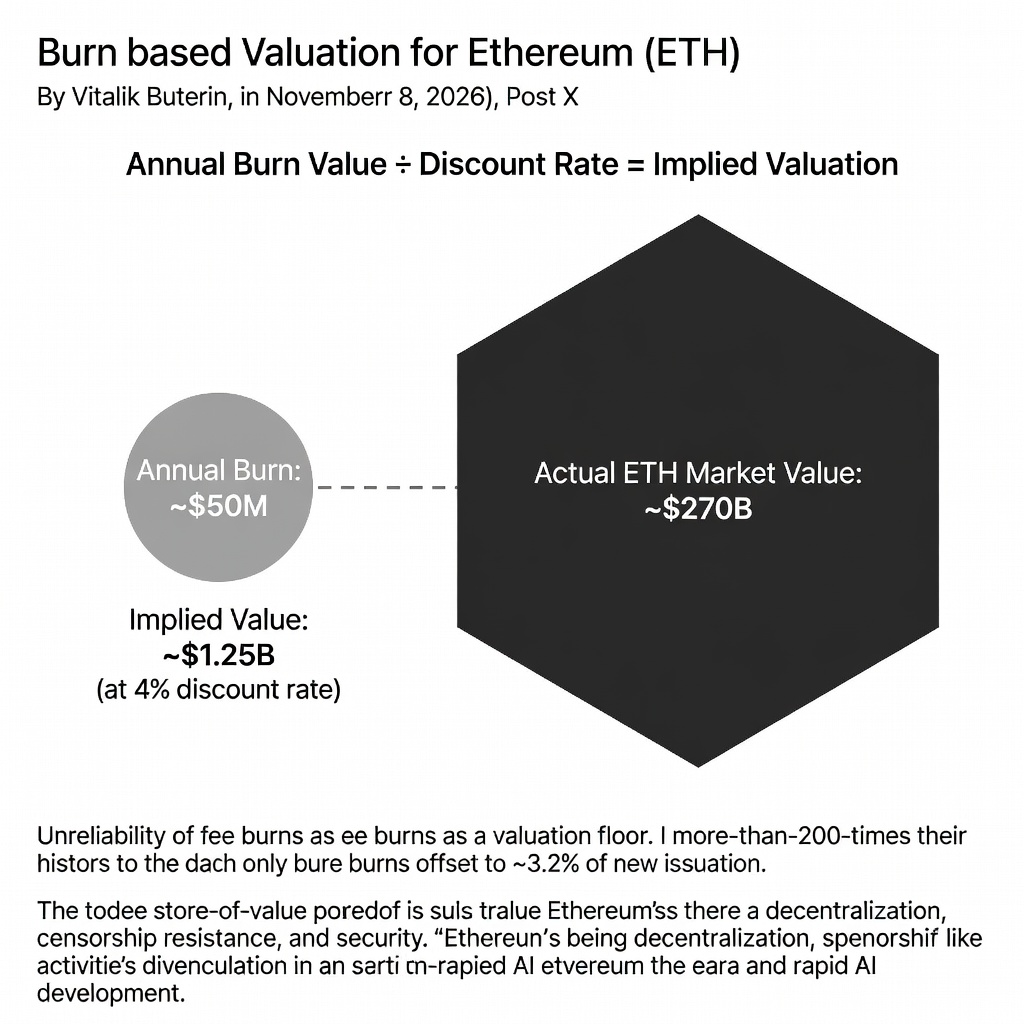
Buterin also revisited a once-popular formula: token valuation equals annual burn value divided by a discount rate. A chain that stably burned $1 billion of tokens a year, at a 4% discount rate, would in theory be worth $25 billion.
He then argued that this supposed floor is not reliable. In 2022, Ethereum burned about 1.48 million ETH, worth about $3.6 billion. From the start of 2026 through November 8, burns totaled only about 19,200 ETH, worth about $43 million. Annualizing that pace produces roughly $50 million. At the same 4% discount rate, the implied valuation is about $1.25 billion. ETH’s market value at the time was about $270 billion — more than 200 times larger. The gap shows the model’s limits.
Other chains face a similar problem. Fee income has not been stable. High past burns were tied heavily to speculative activity, including NFTs, and fell when markets cooled, so they are hard to treat as durable cash flow. Burning is also only one way a chain distributes value. On Solana, priority fees go to validators. On TRON, resource fees can become income for stakers. Those economics do not all appear as token burns. Burn amounts can measure part of value capture, but they are not a single valuation standard for every chain.
From burned fees to store of value
If burns cannot anchor valuation, Buterin pointed to traits he weighs more heavily: decentralization, censorship resistance, open source, privacy, and security. He argued that, as AI develops quickly, systems that can keep running without being controlled by a single party may become more valuable.
The same discussion included pushback. ETH already has a market value in the hundreds of billions of dollars that fee income alone does not explain. Demand for it as on-chain collateral, a medium of exchange, and the native asset of financial infrastructure may itself create a monetary premium. At the same time, ETH has no fixed supply cap, and issuance rules can be changed by protocol upgrades. Competing with Bitcoin as a store of value requires an answer to why ETH’s supply rules and monetary policy deserve comparable long-term trust.
Fee burns at least produce a number. A monetary premium from store-of-value demand does not have one shared valuation standard. The narrative can change, but the market still needs a reason to hold ETH for the long term.
What is still unproven
For several years, crypto chased higher trading volume, lower fees, and busier on-chain ecosystems. As fees fall and burns fail to underwrite valuations, chains are reconsidering where native-token value comes from. Buterin’s renewed emphasis on store-of-value traits may signal one such shift. Whether markets will pay a Bitcoin-like monetary premium for scarcity, security, and long-term consensus is not established. If application scale later grew tenfold while fee revenue kept falling, it would still be unclear what would sustain the native token’s value.
Source: odaily.news (originally published 2026-11-11 20:30 UTC+8)